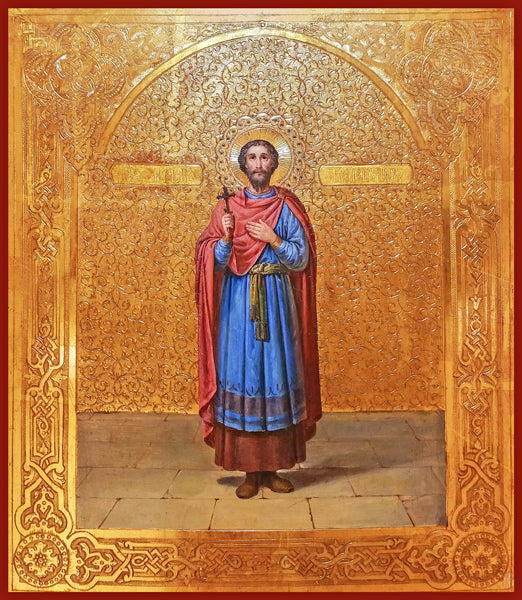
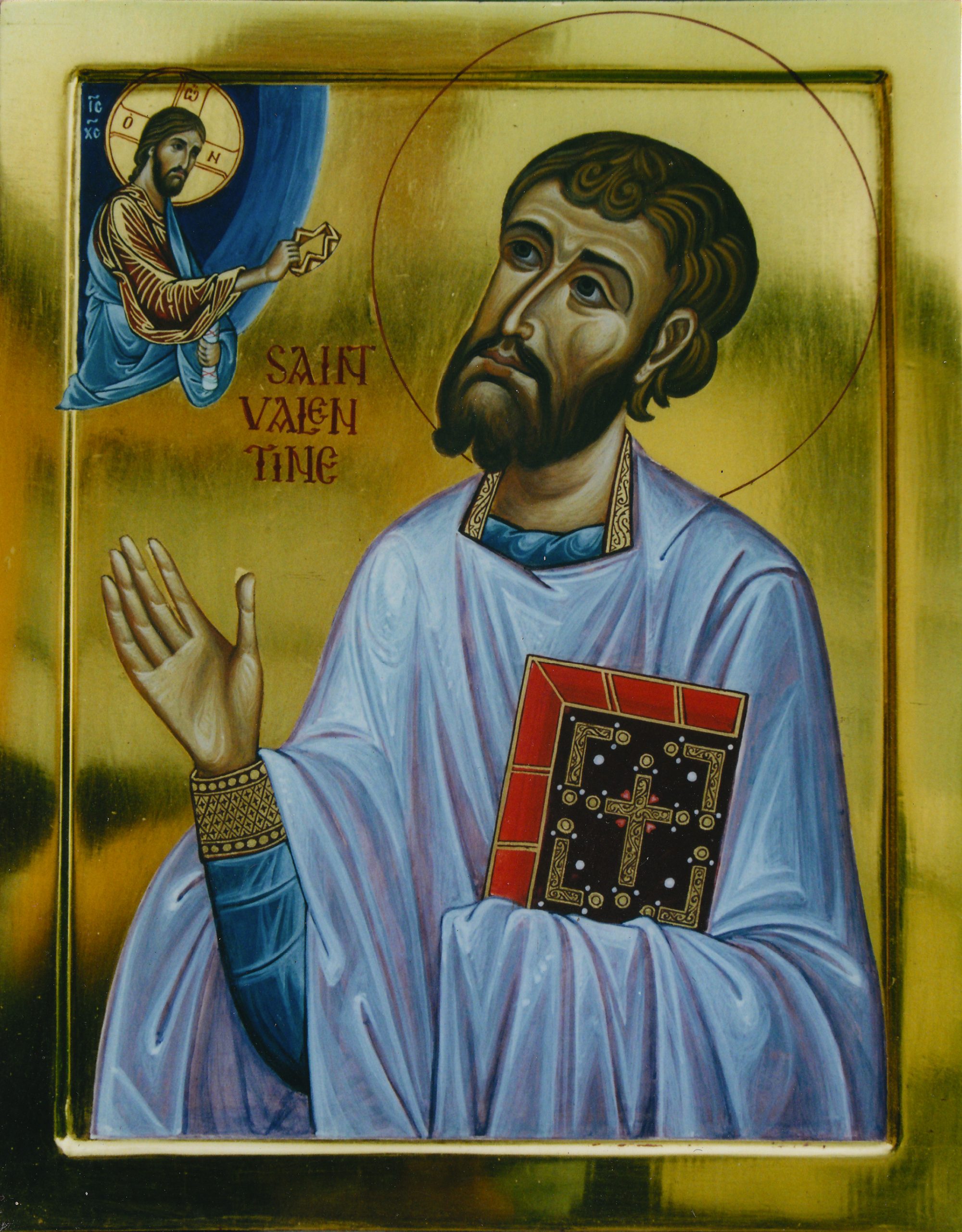
St. Valentine (Valentinus) was not the only St. Valentine alive in the 3rd century, as there were multiple people in the Roman world with the name “Valentinus”, which is Latin for “vigor”. St. Valentine the Presbyter of Rome, St. Valentine of Terni, and St. Valentine of Bulgaria all existed in the 3rd century and were all martyred under the government of Emperor Claudius. The one most well-known in the West, for which the day is named after, is likely the first Valentine, St. Valentine the Presbyter of Rome.
If you read something like the Prologue of Ochrid, you will find on July 6th the reading for “The Holy Martyrs Marinus (Marius) and Martha, with their sons Audifax and Abachum (Habakkuk), Valentine the Presbyter, Cyrinus, Astyrius (Asterius) and many others.”
In the East, where St. Valentine is less known, he’s commemorated in July. This discrepancy is explained simply in the fact that many places in the Orthodox world have a preference or different set day in which they commemorate saints. In the West, February 14th was the day traditionally celebrated.
As you can see, St. Valentine was certainly not alone in his martyrdom at any rate. Further in the prologue, he’s given a short story:
“The priest Valentine was handed over to a commander, Astyrius, so that he would counsel him to deny Christ. But Valentine by his prayers healed Astyrius’s blind daughter, who had been blind for two years, and then baptized Astyrius and his entire household. All of them, in various ways, underwent suffering and death for Christ, Who received them into His Immortal Kingdom, to rejoice eternally.”
The OCA website’s lives of the saints (which is based off the Moscow Patriarchate’s Reference Book for Clergy-Servers) affirms this view of the presbyter:
“The pagans beheaded the courageous confessor Valentinus the Presbyter, and the imperial gardener Asterius who had been converted by him…”
What neither of these sources include is St. Valentine’s association with romance. Many variants of the story in western circles state that St. Valentine was despised by Emperor Claudius for his secret arrangement of marriages of young men, thus exempting these young men from military service. However, this policy was not common in the Roman empire; men would be conscripted to the army, married or not, and the only times in which marriage was not allowed according to Roman records was Emperor Augustus and the Severan dynasty, with Septumus Severus overruling these laws of anti-marriage. Both saints were martyred almost 50 years after Septumus Severus, meaning it’s unlikely this story of rogue marriages was actually associated with St. Valentine. It is definitely likely that there was a Christian priest who did that sort of thing before, but probably not the Valentine we know in our hagiography. Looking at Papal sources like the Passio and Legenda Aurea also confirm that there’s no romantic link. With that many sources and almost none of them with that story, it’s hard to say that St. Valentine’s romantic link is based in reality.
Some other legendary attributes ascribed to St. Valentine are that he cut out heart-shaped pieces of paper, to remind fellow persecuted Christians of the love of Christ and their vows unto the Lord. Additionally, it’s said that his final letter he left to St. Astyrius’s daughter that he healed, with the ending missive “from your Valentine.” These smaller details are a bit more believable; early Christians definitely used more secretive symbolism to spread messages, such as Christograms, and his final letter probably did read similar to that famous phrase, as letter writing was (and still is) considered a rather affectionate act associated with love, although more so a familial love rather than eros.
St. Valentine’s Day Now
St. Valentine’s Day is simply called Valentine’s Day now, and most don’t even know it’s origins or some of the symbolism behind the hearts, the “your Valentine” phrase, or anything like that. Valentine’s Day for many has been whittled down into simply a show of lustful pride, where people indulge their desires. Even the celebration of marriage, which was apparently a huge part of the Valentinian narrative, has gone completely unnoticed as modern people live in a society where marriage is widely frowned upon because of massive divorce rates and atomization.
While it’s in a sorry state, it is not irredeemable. St. Valentine’s Day still is widely celebrated despite all this, and it can still be used to bring people back to Christ by explaining it’s true meaning and what true love really looks like.
The word “love” in English hasn’t changed it’s definition too much over time; in Old English, the word was used to describe any type of strong affection, sexual or not. That doesn’t mean they thought it was the same thing, but context was to be used to differentiate between the two. In Greek, you have several different terms that could equate to “love”: filos, eros, agape, etc. It’s not necessarily that we don’t have other words in English, but that this old definition of love has been corrupted in a corrupt society, where “love” is held to an almost sacred degree despite almost no coherent meaning by itself. Lust, charity, and love, could all be considered separate. So what really separates love from those other two, or any other state of being?
St. Paul perhaps is one of the best people who’s spoken on the subject, in his famous first letter to the people of Corinth. He tells the Corinthians in the 13th chapter how important love is and the attributes of it. The King James Version translates this specific instance of “agape” as “charity”, which is not necessarily wrong, but this is the same word Jesus uses to describe “the love of God” and how “love will run cold.” St. John uses “agape” to say “God is love,” so St. Paul’s description, therefore, is describing God’s characteristics. If God is love, it fits perfectly into Orthodoxy because the purpose of Christian life, which is theosis (becoming more God-like). We are to become love if we are to become like God, and vice-versa.
More than anything, love is sacrificial. This is why the modern definition of love can’t work, because that “love” or really lust is self-satisfying. The point of love is an active sacrificial existence, constantly giving up something for the betterment of another. St. Valentine, all 3 of them, represent the ultimate kind of love in their martyrdom. Their love of God unites them in ways they couldn’t fathom, and in ways we can’t quite fathom either. Marriage is a type of martyrdom that unites two people who become one flesh (according to St. Paul) and the basis of marriage is sacrifice for the spouse and children.
My hope in the future is that when we celebrate St. Valentine’s day in the church, instead of focusing on fleeting ideas of lust and butterfly-in-stomach feelings and sensations of romance, we can instead re-focus on what real love looks like, and how our relationships with our families and spouses can be transformed. Not by passionate desire, but offering oneself as a sacrifice. That’s how our relationships with one another and with God will be restored, and St. Valentine’s day will cease to be a day of heartbreaks and fleeting lust, to divine eros.
May St. Valentine of Rome, and all other Valentines and Valentinas pray for us. Amen.
Gallery